

Dec 22, 2025
Imagine a Tuesday afternoon in May. You’re in a city of eighty thousand people. It’s a boom town. in the deep boreal forest of Northern Canada. Yeah.
Life is good. The economy’s humming. But the air feels wrong. It’s eighty eight degrees in a place where it should be closer to fifty. Humidity has dropped to levels you’d expect in Death Valley, not the subarctic.
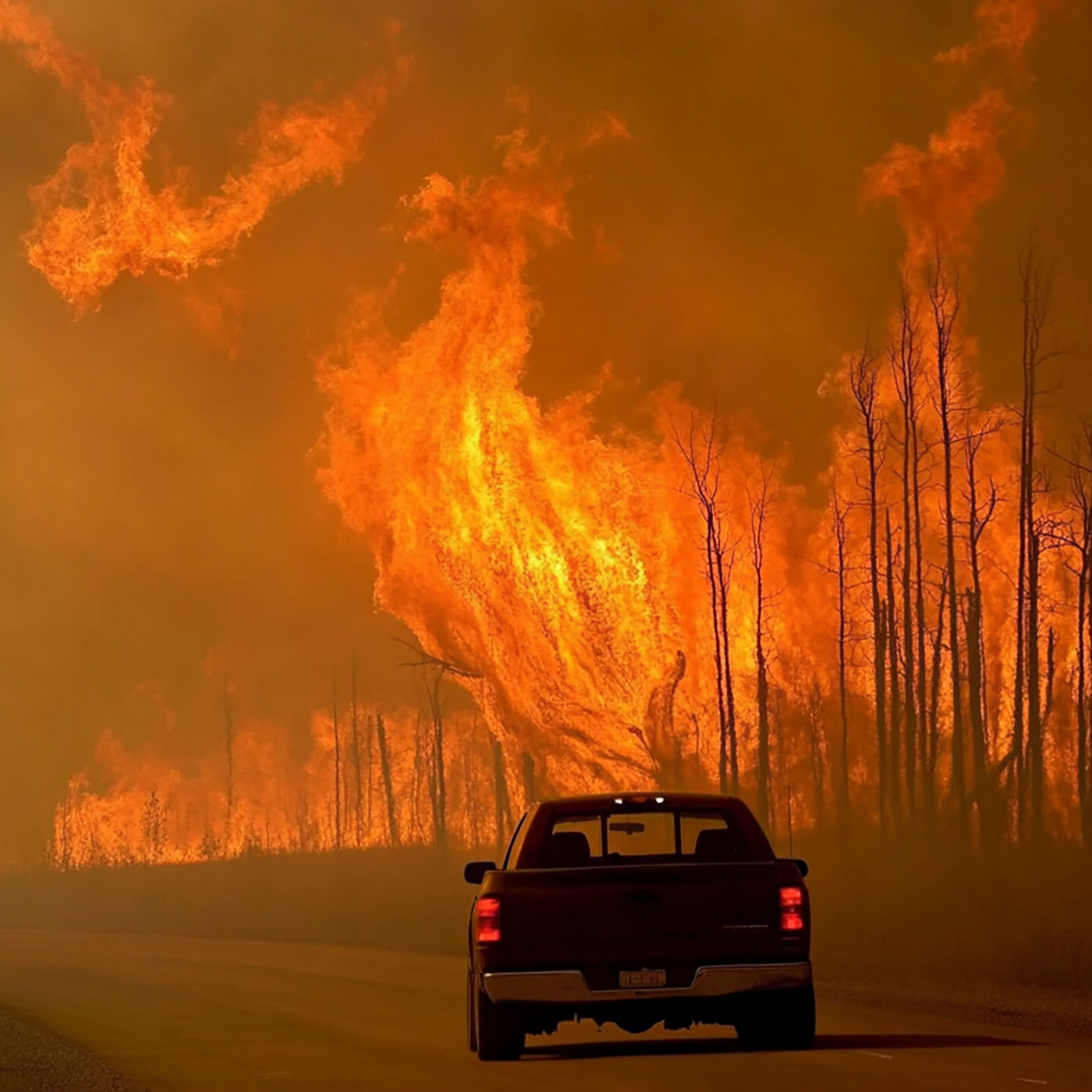
Then you look at the horizon. You see a plume of smoke so massive it looks like a volcanic eruption. Within hours, your neighbor’s house isn’t just on fire. It’s gone. It didn’t burn.
It exploded. The vinyl siding on your own car melted away while you’re sitting in the driveway. This is not a scene from a disaster movie. This was Fort McMurray
Alberta.
Alberta in twenty sixteen. Welcome to the show.…
Today, we are discussing one of the most terrifying and essential books of our time, Fire Weather. A True Story from a Hatter World by John Valant. Valant is a master of the ecological thriller, but this isn’t fiction. This is a biography of the fire the locals called the beast.
But more than that, it’s an investigation into why fire is changing why it’s becoming more predatory, more intense, and more frequent. Valant argues that we’ve moved past the whole and entered the pyrocene age, the age of fire. Today, we’re going to break down the science of fire weather, the irony of where this disaster happened, and why the beast was a warning shot for the rest of the planet. To understand fire weather, you first have to understand that fire is actually a process. That process has fundamentally changed because of the way we have changed the atmosphere.
Valence spends the first third of the book explaining the new fire. For most of human history, fire was a tool. We controlled it in our hearths, in our engines. But the fire that hit Fort McMurray was something of a new order. There is a rule in firefighting called the thirty thirty thirty rule.
It’s the recipe for catastrophic temperatures above thirty degrees Celsius. It’s the recipe for a catastrophe. Temperatures above thirty degrees Celsius, that’s about eighty six Fahrenheit, relative humidity below thirty percent, and wind speeds over thirty kilometers per hour. On the day the beast arrived, those numbers didn’t just meet the threshold. They actually shattered that threshold.
But it wasn’t just the trees. one of the most haunting parts of Valence reporting is how he describes the fuel of a modern city. About your house right now. Fifty years ago, your furniture was wood, wool, and cotton. Today, it’s polyurethane foam, polyester, and plastic.
And Valant explains that plastic is essentially solid petroleum. When a modern house catches fire, it’s not burning like a log. It burns like an oil well. The heat released is exponentially higher. So the beast was so hot, reaching temperatures over a thousand degrees Celsius, that it created its own weather.
It generated pyrocumulonimbus clouds. These are literal firestorms that create their own lightning, which then strikes the ground and starts more fires. It was a self perpetuating engine of destruction. And there’s a quote in the book that stays with me.
Valant describes the radiant heat of this fire as a physical weight. It could ignite a house from across the street without a single spark touching it. The heat alone was enough to reach the auto ignition temperature of the wood inside the other house’s walls. So
This is the fire weather the title refers to. an atmospheric condition where the air is so thirsty, so dry, that it sucks every molecule of moisture out of the plants, soil, and buildings around it and turns the entire world into kindling. So now we have to talk about the setting. This is the part of the book that feels like tragedy. Fort McMurray, Canada, isn’t just any town.
It is the heart of Canadian oil sands. It is a city built on bitumen, the heaviest, most carbon intensive form of petroleum on earth. This is a town that exists entirely to pull fossil fuels out of the ground to power our civilization.…So Valence spends some time tracing the history of the oil industry.…he takes us back to the eighteen hundreds to the first discoveries of rock oil and shows us how we transitioned from a world powered by mussels and wood to a world powered by ancient buried sunlight.
The irony is staggering. The people of Fort McMurray hardworking, brave, resourceful, were the ones who suffered the most from a climate doer in disaster fueled by the very product they spent their lives extracting. Valant doesn’t write this to be judgmental or preachy. He writes it to show the circularity of our current situation. We burn carbon to power our lives.
That carbon warms the atmosphere. That warmed atmosphere creates fire weather. And that fire weather returns to burn the very places where we extract the carbon. He describes the bitumen itself as dark matter. It’s incredibly difficult to get out of the ground.
It requires massive amounts of energy and water. And in twenty sixteen, the forest surrounding these massive industrial sites a forest that had been drying out for decades due to shifting climate patterns, had finally reached its breaking point. There is a moment in the book where he describes the fire jumping the Athabasca River. This is a river nearly a kilometer wide in some spots. And, certainly, didn’t matter to the fire.
It threw embers over the water like it was nothing. It was a reminder that our industrial might, our massive machines, and our engineered landscapes are completely at the mercy of the elements once the beast is unleashed. So if the first part of the book is science and history, the second half is a survival horror story. Valant interviews the people who were there. The fire captains who realized within minutes that their equipment was useless.
parents who were stuck in gridlock on Highway sixty three, the only road out of town, while flames towered hundreds of feet over both sides of the road. One of the most vivid descriptions is of the black sun. The smoke was so thick it turned day into night. But the night was glowing orange. People were driving through embers that looked like tracer fire.
The psychological impact Valant describes is profound. When we think of home, we think of, first, of safety, We think of the most permanent things in our lives. Fire weather shows us how quickly that permanence can evaporate. There are stories of people returning to their lots and finding nothing but the metal coils of their mattresses and puddles of melted aluminum where their car used to be. But Valeon’s biggest point and the reason this book is a must read is that Fort McMurray was not a one off.
Since two thousand sixteen, we’ve seen this pattern repeat. We saw it in Paradise, California. We saw it in Litton, British Columbia. Which was erased from the map in a single afternoon. We saw it in the twenty twenty three Maui fires.
The beast is unfortunately no longer a rare visitor. because the atmosphere is warmer, it can hold more water. But that water isn’t in the ground. It’s in the air. This leaves the land explosively dry, Valant argues.
And that we are fundamentally unprepared for this. Our building codes, our firefighting tactics, our insurance models are all based on a twentieth century climate, and that climate no longer exists. So as we wrap up, I wanna leave you with the central question of John Valen’s book. How do we live in a world that is becoming more flammable? Fire weather is a heavy read, but it’s not a hopeless one.
Really, it calls for clarity. Valant wants us to stop looking at these fires as natural disasters in the traditional sense. They are human influenced disasters. We have invited the fire back into our lives by changing the chemistry of the air. He calls this the pyrocene because for the first time in human history, fire is the dominant force changing the planet’s landscape.
Not ice, not water, but fire. if you haven’t read this book, I cannot recommend it enough. It’s a rare piece of nonfiction that manages to be a page turner while also being a deeply researched scientific and historical text. It will change the way you look at a forest, the way you look at your stove, and certainly the way you look at a hot windy day. The beast of Fort McMurray eventually burned itself out, but the conditions that created it are only expanding.
We are all living in fire weather now. Thanks for listening